Executive Article · Published 16 November 2026
The Organisation Still Needs a Route
By Tunde John — The Contract Architect™
PROSELOGIC Nigeria Limited
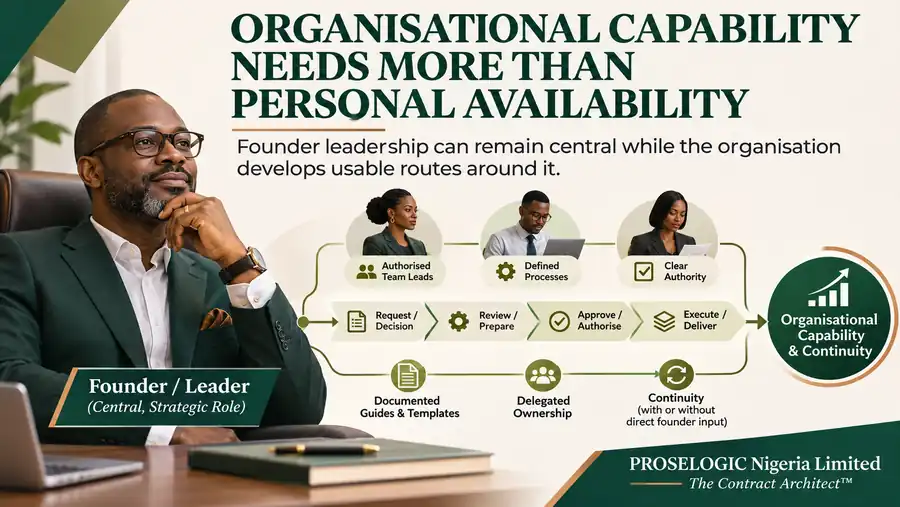
A founder can be one of the strongest assets in a business.
That strength becomes an institutional question only when important activity cannot move appropriately without that person.
Those are not the same thing.
Leadership can be concentrated by design. Strategic approvals can be reserved. Specialist expertise can sit with one person because that expertise is genuinely part of what the business offers.
The issue is not concentration by itself.
The issue is whether the organisation has a workable route when continuity-relevant activity needs to move and the usual person is unavailable.
That is the point at which personal capability and organisational capability begin to separate.
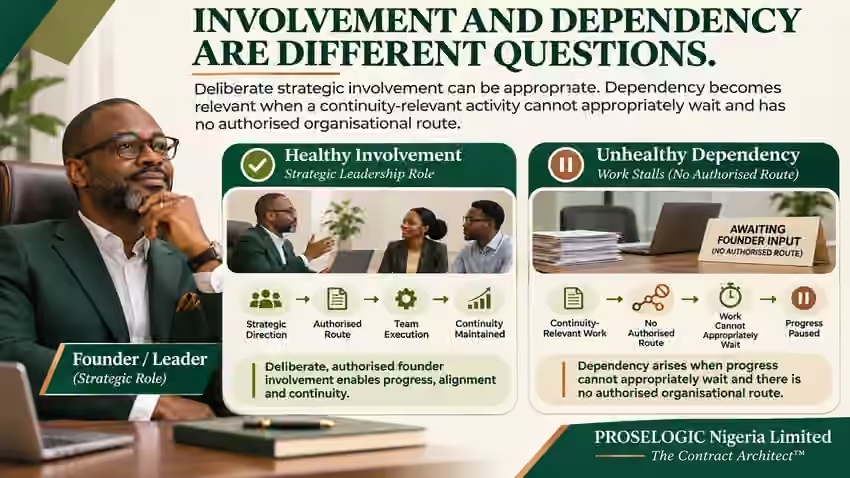
In an SME, a founder may sit close to client history, pricing logic, supplier relationships, project decisions, approvals and exceptions. That proximity can make the business responsive while the founder is available.
Institutional capacity asks a different question:
Can the organisation use the capability it has through defined structures, or must important work repeatedly return to one individual before it can continue?
A reserved matter that can appropriately wait is not a problem by that fact alone.
The concern appears when the activity cannot appropriately wait and the business has no adequate authorised or usable route.
That is where continuity exposure can begin.
PROSELOGIC examines this territory through four existing areas: the Four Pillars of Institutional Independence.
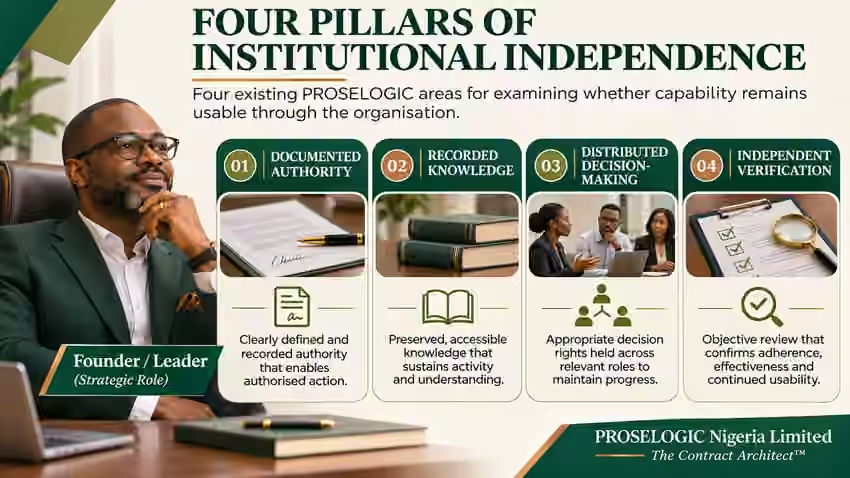
Documented Authority asks whether the organisation can identify who may approve or act, and within what boundary.
Recorded Knowledge asks whether important operating knowledge can be accessed through the organisation rather than existing only in private memory or private channels.
Distributed Decision-Making asks whether defined decisions can actually move through appropriately authorised people within established limits.
Independent Verification asks whether relevant organisational facts, actions or controls can be confirmed from records or established processes without depending entirely on one person's explanation. This is not, by itself, an audit requirement.
The point is not to remove the founder from the business.
The point is to make the organisation less dependent on the founder for matters that should be able to move through the institution itself.
This matters operationally.
If a client issue, supplier matter, approval or project response reaches the business and nobody else can move it appropriately, the organisation may have genuine capability but still lack an institutional route for using that capability at the required moment.
The same distinction can become relevant externally.
This analysis does not claim that evaluators score founder independence or that founder involvement automatically weakens a bid.
The applicable solicitation or institutional process determines what must be demonstrated.
Where a process asks for relevant organisational capability — for example personnel, authority, controls, methodology, records or delivery arrangements — the business may need to show how that capability exists through the organisation, not only through one capable individual.
If the relevant capability is inseparable from one person's memory, informal authority or availability, it may be harder to demonstrate or use as organisational capability within that specific process.
The practical lesson is not “delegate everything.”
It is to look at where continuity-relevant activity actually depends.
Take a routine activity that matters.
Do not score it.
Do not turn it into a company-wide test.
Simply observe whether the organisation has an appropriate route for that activity when the usual person is unavailable.
If the activity is deliberately reserved and can appropriately wait, that may be entirely proper.
If it cannot wait and there is no authorised or usable route, that is one point worth examining further.
One functioning route does not prove the whole organisation is institutionalised.
One blocked route does not prove the whole organisation is dependent.
The value lies in seeing the structure more clearly.
A capable founder and a capable institution are not opposing ideas.
Founder leadership can remain valuable while the organisation develops enough structure for continuity-relevant authority, knowledge, decisions and verification to remain usable through defined organisational routes.
That is the institutional question.
Not whether the founder matters.
Whether the organisation can still function appropriately around that leadership.
If this changes how you look at one of your own processes, keep the details private and send me a message with the general distinction you are considering.
Tunde John
The Contract Architect™
PROSELOGIC Nigeria Limited